

Many schools fail to teach the essential skills needed for future careers and life. They do not adequately prepare students to navigate challenges and succeed as adults. While schools are expected to provide the necessary knowledge and skills, some important lessons are hard to convey in a classroom. We must ensure the next generation is truly equipped for their futures.
To illustrate this point, let’s reflect on our own school experiences. What did you learn? Here’s a more thought-provoking question: What didn’t you learn that you wish you had?
What is school supposed to be? Below is the definition of education according to the 1828 Webster Dictionary.

Now, consider your schooling experience as it relates to this definition. Did your education instruct you or discipline you? Did your school experience enlighten you, correct your temper, or form manners and habits of youth? Did school fit you for usefulness in your future stations? Noah Webster had a holistic view of school.
Now is a good time to reflect on our own education as children head back to school. Our children need to learn what we learned many years ago. Often, education focuses on facts and information. But is that really the method for teaching all the other essential life skills?
The Problem
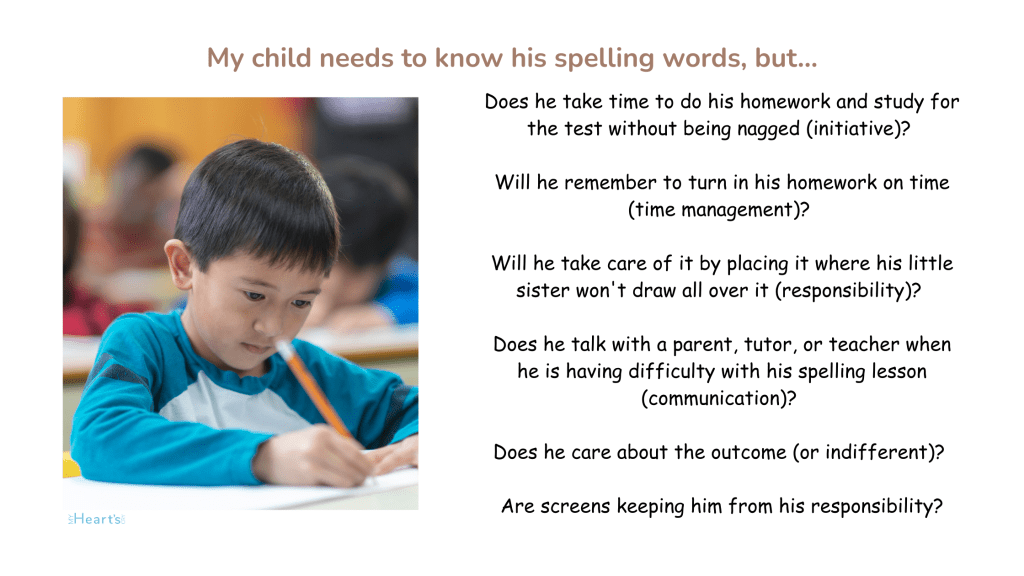
When speaking with employers who have employees in their 20s, they often express concerns about what schools and parents failed to teach or enforce. Many young adults struggle to stay focused on tasks. The managers’ primary concern is the lack of motivation and initiative among these individuals. However, several other issues were noted including a lack of professionalism, excessive phone use, poor time management, and an indifferent attitude. Other concerns included poor communication skills, difficulty in handling feedback, and an inability to adapt to the company culture.
This is not a new problem. Just look at Webster’s gripe with parents who neglect their responsibility to teach their children. This is why parents need to do their part in teaching these traits to their school-aged children. But how?
Some Solutions
- Teach self-care by prioritizing the health of both body and mind. Eating a balanced diet and getting sufficient sleep are essential for a child to succeed in any responsibilities they are given.
- Inspect what you expect. Check to see if Jr. is keeping up with their responsibilities and ensure they are meeting the standards outlined when the responsibility was assigned.
- Curb phone use. Set boundaries on when teens are allowed to use their phones. When we were kids, we didn’t get to play or hang out with friends until our homework and chores were done. It should be the same today. Because kids spend time on their phones daily, setting phones to “do not disturb” until homework and chores are completed is a good rule for kids.
- The carrot/stick method is a motivational technique that uses both rewards and punishments to encourage desired behaviors. It involves offering something desirable (the carrot) to those who comply with expectations and threatening negative consequences (the stick) for those who don’t. When children are properly motivated, they develop initiative and lose the indifferent attitude.
- Communication. Provide opportunities for kids to talk to a variety of people. Church is a good place for them to learn to talk to all ages and types of people. Kids only engaging other kids, does not help them grow in their communication skills. Purposefully put your child where they will have to talk to adults. They will need the ability to respectfully make requests as well as answer questions and explain themselves.
Whatever schooling method we choose for our children, the desired outcome is for them to become contributing members of society. A motivated worker takes initiative, knows how to manage their time and projects well, doesn’t steal from their employer by using their phones or computer for personal use during business hours, knows how to be professional, receives constructive criticism well, and can communicate successfully. Let’s do better in preparing our school-age students for the “real world”.
Finally I’m reminded of these verses:
Whatever you do, do all to the glory of God. I Corinthians 10:31b ESV
We aren’t slaves, as the verse below states, but I think it applies to our work experience: what we do matters to God. Note: words in parentheses. are mine.
“Slaves (employee), obey your earthly masters (employer and/or manager) with deep respect and fear. Serve them sincerely as you would serve Christ. 6 Try to please them all the time, not just when they are watching you. As slaves of Christ, do the will of God with all your heart. 7 Work with enthusiasm, as though you were working for the Lord rather than for people. 8 Remember that the Lord will reward each one of us for the good we do, whether we are slaves or free.” Ephesians 6:5-8
Check out my book for homemakers! It has been making its way into their hands for a year.
If you would like the Kindle e-book, it will be $2.99 as part of a special promotion from September 9th to 16th.

My sister and I both worked at restaurants as teenagers maintaining the salad bars. We recently discovered that we had nearly identical experiences of shocking our bosses by showing initiative. During slower moments in our work days, we each decided to do needed cleaning in the kitchen: me cleaning the gunk off the can opener and my sister cleaning up the dried soup on the stove. In both cases, we made big impressions on our bosses by doing tasks without being asked.
I can still remember the name of a particular student from 1992 because he was the only one out of 90 students who came in during a break for extra help in math. All of this to say, showing initiative can REALLY make you stand out!
Pingback: Essential Skills for Kids for a Successful Career and Life – Career Homemakers